About this episode
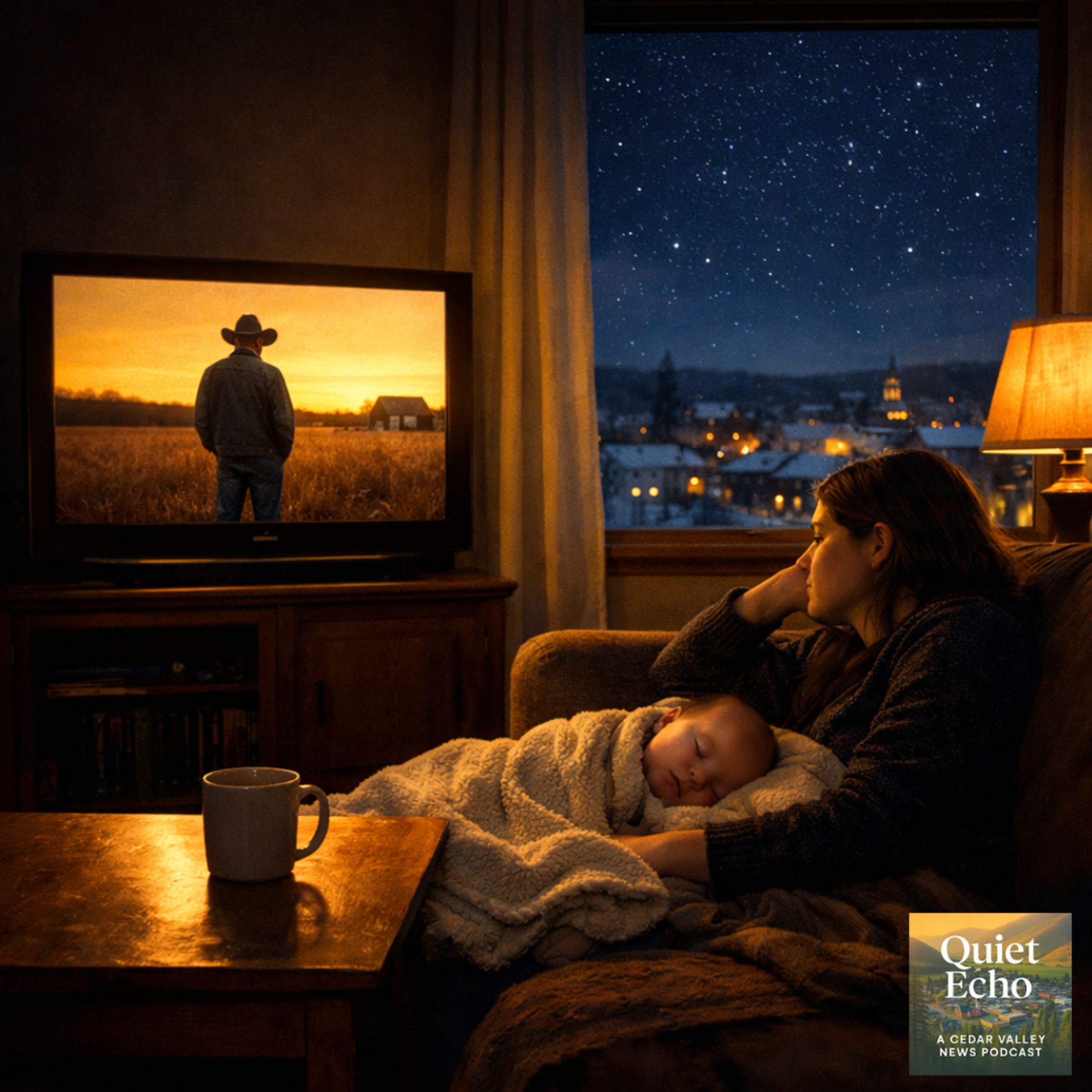
Good morning. Welcome to Quiet Echo. I'm Chloe Papadakis. Teresa is out today and she asked me to take the microphone. I told her I am not sure Cedar Valley wants to hear from a twenty-eight-year-old event planner on a Thursday morning. She said try me. So here I am. Robert Duvall died Sunday. He was ninety-five years old. He died at home on his farm in Virginia with his wife beside him. And his family asked us not to hold a funeral. Instead, they asked us to watch a great film, tell a good story around a table with friends, or take a drive in the countryside. I have been thinking about that instruction all week. It is the most beautiful thing I have ever read in an obituary. I did not grow up watching Robert Duvall the way my parents did. I came to him late . . . the way you come to anything real, by accident, when you are finally ready to pay attention. My husband put on Tender Mercies one night after our daughter was born. It was during those sleepless first weeks when the house smells like milk and everything feels raw and close to the surface. I watched a man lose everything . . . his career, his family, his dignity . . . and find a small town, marry a quiet woman, and rebuild his life one careful day at a time. He sang his own songs in the film. He did not raise his voice. He did not need to. When it ended I sat in the dark and cried. I could not explain why, except it felt like watching someone tell the truth. That is what Robert Duvall did for sixty-three years. He told the truth. He walked onto a set and became someone else so completely the audience forgot they were watching a performance. Tom Hagen in The Godfather . . . calm while the world burned around him. Gus McCrae in Lonesome Dove . . . dying on a porch, asking his friend to carry him home. The Apostle . . . a broken preacher rebuilding a church with his bare hands because the calling would not let him quit. He was nominated for seven Academy Awards. He won one. But the awards are not the point. The point is, he never disappeared into fame the way actors do now. He disappeared into the work. There is a difference. Fame makes you bigger. Work makes you truer. Duvall chose truth every time. I think about this because I am a mother. And mothers think about what gets passed down. My daughter is two. She will not remember Robert Duvall. She will not know what it meant to watch a man commit his whole life to a craft and never cut corners. Never chase trends. Never trade substance for attention. But I will know. And what I know shapes what I teach her. We live in a world built on disappearing. Content vanishes in twenty-four hours. Attention spans shrink by the season. My generation was raised on feeds and stories and posts designed to be forgotten by morning. We consume and scroll and consume again. Nothing stays. Nothing is meant to stay. Duvall stayed. His first film was in 1962. He played Boo Radley in To Kill a Mockingbird . . . a ghost who turns out to be the most human character in the story. His last film came more than sixty years later. Between those two bookends he built something the algorithm cannot replicate. He built a life of showing up, doing the work, and letting the work speak. I was telling Teresa about this column yesterday at the office. She raised an eyebrow and said Cedar Valley does not usually do Hollywood obituaries. I told her this was not a Hollywood obituary. This was about craft. She smiled and said, "Then it belongs in the paper." She is right. Craft belongs everywhere. It belongs in Lars Olson's hardware store, where he measures twice and cuts once because the board deserves his attention. It belongs in George Khan's repair shop, where a lawnmower gets the same care whether the customer is watching or not. It belongs at Caleb Mercer's workbench, where a dovetail joint is a dovetail joint whether anyone will ever see it. Duvall would have understood Cedar Valley. He lived on a farm. He did not chase the spotlight. He tended his land,
Comments
Rate this episode
Episode Details
- Show Type
- full
- Audio Format
- audio/mpeg